Friday, September 28, 2012

SCBWI Carolinas Annual Fall Conference

This weekend I'm at the SCBWI (Society of Children's Book Authors and Illustrators') Annual Fall Conference in Charlotte, NC.  I love coming to this conference every year for the great speakers and wonderful cameraderie! 

Since I'm at the conference there will not be an author interview this week.  But here are a few photos highlighting the first day of this wonderful three-day conference!

Today started for me with a 5 am alarm clock ringing.  My friend Jenny and I grabbed our suitcases and laptops and drove the 3 hours to the conference center/hotel here in Charlotte, NC.  (Ugh! So early! Coffee please!) 

The morning began at 8am with a wonderful Intensive Seminar by Author Helen Hemphill (Director of the Highlights Whole Novel Workshop) who gave us tips on revising our novels using story-boards and other outlining/plotting tools and story arch, and who helped us learn to balance the amounts of "scene and summary" in our novels. It was great! Thanks Helen!


The afternoon consisted of 1:1 critiques with agents, editors, and experienced authors,  trips to the SCBWI conference book store to buy books on craft and books written by Carolina SCBWI Members, and times of reflection with old friends who we haven't seen since last year's conference.

More seminars followed, including a great agent panel with agents Sarah Lapolla (Curtis Brown Ltd), Liza Pulitzer Voges (Eden Street Literary),  and Jennifer Rofe (Andrea Brown Literary,) and a wonderful end of evening seminar in which Middle Grade Author (AKA Computer Guru) Stephen Messer taught interested authors how to back up their work using the Dropbox program.  Don't know about Dropbox? Check it out by clicking the link above.


My favorite quote of the day was by Helen Hemphill who said that in this business "the harder you work, the luckier you get."

Overall, it's been a great first day. We look forward to two more wonderful days of seminars and meeting together with fellow authors and illustrators!

Saturday, September 22, 2012

"Each One Teach One" Interview - YA/MG Author Kathleen Duey talks Research and Setting.

We’re finishing the second half of our Interview with Children’s/YA amazing Author Kathleen Duey this week. Kathleen has written more than 80 books for children, middle graders and teens.  Last week and this week we’re using Kathleens’ dark YA Trilogy “A Resurrection of Magic” – the first book of which is the fabulous Skin Hunger – as our textbook as we discuss the craft of writing. J So, welcome! Let’s jump back in:

Kathleen, how would you recommend that writers can keep track of the various aspects of a complex fantasy world? For example, in this trilogy, how do you remember what the caves look like, and how far apart things are, and what the travel is like between places? I see a lot of little notes and visuals all around you in your office in the photo above.  What kind of notes or visuals do you create to help keep all the details of your story straight? Can you recommend a system?

I don’t have any systems.  Every book seems to need different things. I often draw maps that include distance scales when the venue is too big to remember—as this current one is. The cliffs in these books are a massive honeycomb of passages and chambers, the result of centuries of magicians living there and they reflect centuries of the progression of what magic can do.  Maps and sketches are usually part of my development process, regardless of genre. Drawing seems to help me discover things making a list wouldn’t have. I wrote a timeline for this trilogy, too, just to keep things straight.

Timelines and maps. It sounds like you use a lot of visuals. That reminds  me of what  Tolkien did for his very complicated Lord of the Rings Trilogy too.  As a reader I was always fascinated by the maps of the lands that the publisher actually  included in the books to help readers keep track visually of the distance between places as well. Great suggestion on visuals!


 On a separate theme, I know you’ve done quite a bit of research which has helped you make these books believable and realistic, and has helped us as readers find your book "worlds" believable.  Some of us love and others hate research.  Yet research is so very important to bring believability to fiction.  Just for fun, can you give us a list of some of the topics you researched in order to write this trilogy? (I know you’ve also studied up on many other topics for some of the other 70-some children’s books you have written J)!

I like research.  No.  I LOVE research. My middle grade books are often historicals. Research almost always suggests character or plot details. I also draw from my own life, like every other writer on the planet. Some of the topics below were researched online, others involved interviewing random strangers on airplanes or by phone or email.  Some included buying and reading old musty books.

Partial Research List:

Effects of sleep and light deprivation

Cheese making

Goat breeds

Utopian communities/communes

Long term effects of memory loss

Buskers and Street performers

Megalomania 

Flight dynamics

Stick and Sword fighting

Gender identity

Crowd hypnosis

Near death experiences

Contemporary magicians

Circular breathing

Contact juggling

Oh my! So, is `contact juggling' what people do at night when they’re removing the contacts from their eyes and putting them into little white case with the solution? Or does that mean people actually juggling other people? J Either way it sounds very tricky!  Also, exactly how many breeds of goats did you actually used in your story?  What fun topics! 

 Here’s another question: You do a great job of mixing in dialogue and action in combination with descriptions of the setting (for example in pages 1-5 of Skin Hunger - read them here by clicking the book and selecting "first pages"). Can you give any tips on knowing when too much description is way too much, and when we need to start sticking in some action?

 Thank you again!  I have gotten better at this, I think. I would love to rewrite that passage and trim a little more…. This is something I almost always address with the people I critique/consult. A created world gives the writer WAY too many excuses to describe things that stop the story, and muddle/obscure/drown out  the character’s real voice—but I have read long, detailed descriptions of contemporary high schools that do the same thing.
I don’t have a set of rules about any part of writing, and for some writers and readers, lyrical description is a sign of literary merit.  I think that anything that makes the reader remember they are reading is probably a bad idea, even if they step out of the story to admire my prose. If writing long graceful description helps you see and feel the story, do it. Consider deleting a lot of it in your second drafts to better serve the story itself.

Wow – great advice! I love the last two lines you wrote there -- "if it helps you see and feel the story, do it," and then later consider deleting a lot of it. That's a great technique and reminds us that that story is really all about the readers in the end.  This has been very helpful. Thanks Kathleen!

Is there an additional gem of wisdom that you’d like to give to other authors about writing or logistics of the profession? 
Yes.  No one expects an artist to sell his first painting to a museum collection. Or his twentieth. None of us think amazing musicians practiced alone in their rooms for six months, then went on tour. Find teachers. Read about your art. Go to conferences and workshops. Expect a 5-10 year learning curve. The market is drowning in books that aren’t ready and there are way too many broken-hearted writers. Take care of yourself.  Learn. Work hard, don’t rush.

Wow! That was said perfectly!  I knew there was a reason I liked you, Kathleen!
So, how old were you when you first started writing? Will you tell us about one of your first writing attempts – even if you were just 8 years old? J  How did it go? 

My  4th grade teacher was my first “reader.” I brought her overly-dramatic stories about heroic girls and their horses, usually near the end of the world or in a terrible snowstorm.  She told me that if I worked hard all the way through school and beyond, and if I got lucky and managed not to give up, she thought I might be able to publish a book one day.  Encouragement and reality.  Oh how grateful I am for both, Mrs. Fredericksen.  Thank you.

Tell us about one of your favorite current or recent projects that you’ve worked on.

I am very excited about this Resurrection of Magic trilogy . I will cry when I send it off, which will be SOON. I am on chapter 77 as I write this, with 2 or 3 more chapters to go. (You can be notified about the release of the book here. ) I will then start two new projects, one for YA and one for MG.  Both are distinct and weird and will be hard to write.  Can’t wait!!!  

Distinct and Weird.  Those sound great! We’ll look forward to reading them!

Huge congrats on finishing of the Resurrection of Magic Trilogy.  I’m sure that ending the series is a wonderful high and also will feel like letting a part of your soul walk out the door to the publishing house when the unpublished manuscript leaves your desk for the last time!  We look forward to seeing how it all turns out in the end!  Fingers crossed, Sadima!
Thanks  again for a great interview. Kathleen!  Not only did we cover “world building” as description of place, but you showed us how the characters and the world impact each other and can and should be seamlessly woven together! Now we're all going to run off and try to do that!

Next Saturday I'll be at the SCBWI Carolinas 20th Anniversary Conference in Charlotte, NC., and will send out a brief report from there, including names of the winners of our great book give-away!  Keep your eyes peeled for more great author interviews coming up after the conference. Experienced authors will continue sharing with us on specific themes, and we'll all learn together. 

Thanks again, so much, Kathleen, for your great tips on World Building, Research, and mixing action and characterization properly amidst description of place.  You're awesome! 

For those readers who want to learn more about Kathleen's books and her craft don't forget to check out her fabulous website and blog, or follow her on facebook. See you next week!
- Janelle


Friday, September 14, 2012

"Each One Teach One" Interview - YA/MG author Kathleen Duey talks "World-Building"


If you're trying to create a believable fictional world in your YA or MG manuscript then you're lucky that you came by the blog today to read the interview by this week's Awesome Author Kathleen Duey. I first discovered Kathleen when I read her book Skin Hunger, the first in her YA trilogy "A Resurrection of Magic" a few years back.  I was amazed to find she's written (if I'm counting right) some 80 books for children and teens.  How could any one person ever have time to do that? 
 
Well, Kathleen, we're all dying to know -- with that many books under your belt, who on earth was it who helped you when you first started writing?  Once we've discovered that : ) I'd love to ask you to share tips on World-building with us today. 
 
Ok. When I began writing I lived on an isolated off-grid farm. I wrote at night on a typewriter, by candle light, and was a full-time mother by day. I finally sold a children’s novel, then two middle grade series to Avon Books--a paperback imprint that later merged with Harper Collins.  Once I had electricity and a computer to work on, I decided to write longer, more complex books for teens, too. My editor sent me AFTER THE RAIN, a book by Norma Mazer.  I tried to read it as a student of craft, to pick it apart and learn from it. I couldn’t.  The story was seamless and the craft was invisible and my heart was captured. I wanted to do what she did. I wanted to write books that made people forget they were reading.  

                I wrote Norma a letter and I didn’t expect an answer, but I got one.  She
                had read two of my books and liked them. We began calling each other
                and eventually met face to face and shared conference dinners
                whenever we could.  We talked about writing and I listened closely
                when she spoke, of course—but she listened to me, too. Norma gave
                me something much better than writing advice. She gave me the
                courage to believe I was a writer, that I belonged to the ancient
                community of storytellers. It was an enormous gift. I pay it forward
                every chance I get.

             Well Kathleen, I think you have learned very well how to do what Norma did
             in AFTER THE RAIN.  Your books use invisible and complicated skills of the
             craft to create stories that capture the heart.  So today I want to pick your
              brain about one aspect of those invisible skills – World-building – creating
              a believable world for your characters to live in that just seamlessly runs
              throughout the book. 

    Let’s use your dark YA Trilogy, A Resurrection of Magic, as our case study for
    this interview.


In these books you manage to create multiple areas of a magical world
that functions believably throughout multiple centuries as the story
progresses through the trilogy.  Each location and time period that you
create are not only believable, but filled with sights, smells, passion,
danger, and the complex daily life of rich and poor folks living out their
days  in villages, caves, and homes that all revolve around the main
characters.  We are drawn into the story not only because of the plot,
but because of the world. The places and problems in it feel real to us,
the readers.  From young MC Hahp hiding on the roof of his home
listening to the dogs attacking beggars below at night, to the school in
the caves, to the boys in the cage and their horrible teacher -- we
believe the world. And that world makes us believe your story and be
both horrified and amazed by it.  (For anyone who has not read
Skin Hunger, and who is not afraid of the dark, I highly recommend it! :))

 A lot of authors struggle with not knowing how to create a believable
setting, or “world” like this in a novel.  Can you give us some tips on
how to create a fictional world as complex as yours?  What should
writers think about or make sure to include when building a believable
fictional “world?”
               
First, thanks for the kind words. For people who haven’t read the books
(A Resurrection of Magic trilogy): There are two stories, two protagonists.
The first story unfolds over about 200 years. The second story covers
about 7 years. The first story causes the second one….. and the stories
slowly become concurrent in book #3, the one I am writing now.  

So yeah.

The venue is complicated. It has both eaten me alive and improved my
writing.

 What should you make sure to include when you build any kind of

fictional world?  I try to make things logical, integral.  If I want
characters to be part of a community of people bound by generations
of long-held beliefs, I probably won’t give them an ocean, or if I give
them an ocean, I won’t give them boats, at least not to start with. 
Sailors and explorers bring new things into old cultures—stories,
beliefs, spouses from other races, new food, clothing, words,
weapons, etc.  For me, setting, story, and character are entwined
and very hard to separate.

Imagine a boy running up an alley. He sees a limping cat an instant
before he hears shouts behind him. Does he stumble to a stop and
slide the cat into his jacket, then run? Does he kick it aside?  Jump
over it? Does he grab it, hide, throw it into the pursuer’s face and
then run again?  Whatever happens will inform the reader about
the boy, his life, and the story setting. I try hard to let the reader
see the story as it develops.   

 Wow Kathleen, that last paragraph is such a great example of
how the characters actions really do show us who they are. 
You’re so right.  With any of those actions we’d learn an awful
lot about who this boy really is and his motivations.  I love that
example!  And you’re right that when we add something to our
world it’s important for us to remember that the ocean isn’t just
the pretty waves lapping up on the shore.  It means so much
more! And so do so many other little things we’re tempted to add
into the worlds in our books without thinking about the
consequences. That’s a great point!

                            
           So for those authors who want to create a complex world, can you give
            a suggestion about the pre-writing phase? How do you outline or plan out
           your book in a way that allows you  to continue “building the world” through
           each progressing chapter?  Or does it just grow naturally as you go along
           with the writing?

           I usually put a lot of time into imagining the place and time the story will
           inhabit I talk to the characters and I often know how I want the reader
           to feel when they close the book but not how I will get there. Once I
           know as much as I can know…..I don’t plan or outline, I start writing. For
           me, that allows logical growth in the setting. The characters will  
           notice additions/changes/discoveries that matter. They will react, and
           that will inform the reader.

I think it’s amazing Kathleen that you don’t outline! But the way you write your characters does show that you know them well. The characters are very strong and very individual.  What you say makes total sense. If you know them then the characters will behave like themselves in all of your writing.  I’m thinking maybe I need to take a few of my characters out for coffee this week and get to know them a whole lot better! J       
 
Meanwhile, for any readers who didn't sign up for a chance to win
Kathleen's book "Skin Hunger" by posting a comment on last week's
post, you still have until the end of September!  So take a look at last
week's post and jump on in!
 
Next week Kathleen  will answer more questions about world-building and research in fiction.  Thanks Kathleen! See you all then.  

Saturday, September 8, 2012

A Give-Away to say THANKS TO THE READERS!


Sometimes we do something and we wonder -- is this making any difference? Should I continue in this track or should I stop and focus my time and energy elsewhere?

Many parents of teenagers have this question in their minds on any given Tuesday when their heirs-apparent are doing something that makes it seem that they're oblivious to your guidance and love. 
Ha ha.  But of course, as a parent, your impact is important in the lives of your kids.  Statistics continue to show that parents are the most important factor in affecting a teens behavior and success in life.

Many authors have a similar question -- "Is this book I'm writing sale-able? Are the theme and characters going to be interesting to people? Should I keep on as I am or should I stop and write something completely different? The general recommendation of editors related to these novel-writing questions has been repeated at every writing conference in the history of time `write the book you feel called to write, and write it well. Don't try to fit your writing in with the current trend of post-apocolyptic novels, vampires, wizards, or whatever happens to be seemingly going on in the market at the time.  Markets change.  If it's a great book, people will read it! Maybe you'll start a new trend.'

Bloggers, like authors, also have that fear that they're possibly dumping their energy into something that may be totally unsuccesful in the end; something no-one is reading. That's especially true in this era when people don't comment on blog posts! : ) Hee hee.  I've interviewed a number of friends who read blogs and almost all of them say "I really like reading the blogs, but I don't have anything to say that hasn't already been said, so I don't comment."  To those readers I say, your comment is still valuable. But to bloggers I say, don't fear a lack of comments.  Check your stats.

I recently checked the stats of writermorphosis and wanted to take the time today to say

HUGE THANKS TO THE READERS OF THIS BLOG!

WRITERMORPHOSIS STATS THIS SUMMER:

Number of Readers Last month:  831

Readers live in 12 Countries:

United States
Australia
China
Germany
India
Dominican Republic
France
The United Kingdom
Japan
Poland
Russia
&
Greece

Most-read type of posts:  The "Each One Teach One" author interviews.

So, THANKS!  Glad to see that folks are reading the blog!

We'll continue our "Each One Teach One" interview series with tips next week on "World-building in Science Fiction and Fantasy" by Kathleen Duey, author of more than 50 children's/YA books.

BOOK GIVE-AWAY:
To Celebrate the success of the "Each One Teach One" Author Interviews, I'm giving away 3 great books by 3 of our interviewed authors:

Blue - by Joyce Moyer Hostetter
Fantasy Baseball - By Alan Gratz
Skin Hunger - Kathleen Duey

To enter, write a comment on this post saying

1. What type of writing you do (YA, MG, Children's PB, Children's Historical, etc)
2. What state or country you live in
3.  What's been your favorite post on the writermorphosis blog :)

I'll post the names of the 3 randomly selected winners (commenters) of the books on the blog at the end of September.

Thanks for reading Writermorphosis!


Friday, August 31, 2012

Hurricane Preparedness for Writers

Since Hurricane Isaac blew past my house the other day dumping rain and rolling thunder, then moving on to pour down it's wrath on Haiti, Louisiana, and many places in between, I was reminded of an old post here on Writermorphosis that we had fun with a couple of years back.  That post -- meant to be a humorous look at how writers can (and should) prepare for unexpected things like natural disasters (by backing up your work, etc) -- initiated a fun discussion on what real writers do and "should do" to keep their manuscripts and works-in-progress safe from flood, fire, electical outage, or any other sort of disaster.

When I went back to read the old post I noticed that one of our upcoming "Each One Teach One" authors, Kathleen Duey, author of more than 50 books for young readers and teens, including the brilliant Skin Hunger, made a great suggestion at the bottom of the hurricane post, way back in 2008.  Thanks Kathleen!

So, as folks are drying out, wringing out, and cleaning up from Hurricane Isaac, I'm reposting "Hurricane Preparedness for Writers" as today's post. (Click the link to read it!) I hope you will enjoy it, and share your comments on ways to keep your writer's life safe from disaster. : )  Meanwhile for those who are mopping up from Hurricane Isaac -- our thoughts are with you.  For those who wish to assist them, here's a lin to The American Red Cross.

We'll look for Kathleen Duey's "Each One Teach One" interview in Mid-September, as well as other "Each One Teach One" Author Interviews on topics ranging from "fantasy novel world-building," to characterization, to making your way through the publishing industry. See you then!

Happy Labor Day Weekend to those reading this blog in the U.S.!

Friday, August 24, 2012

EACH ONE TEACH ONE: EDITORS & AGENTS at WRITE ON CON


First of all, a quick, sincere apology:  I was volunteering at a great event last weekend in the Dominican Republic called “Kiteboarding For Kids  that raises funds for organizations that help impoverished children on the North Coast of the Dominican Republic. (Check it out! We're still collecting donations if you want to be a part of it!). Alas, I got so busy with that that I completely forgot to post on writermorphosis last week!  I am very sorry. : ( 

Huge thanks to those dedicated readers (I saw you all there on the stats feed graph) who sweetly showed up last Friday and Saturday to look for the missing post.  I’m so sorry! It was a colossal fail on my part!
But I’ve got a great post for you this week, to make up for it! It’s not an interview! It’s a bunch of them!  It’s an online writer’s conference for children’s/YA writers called WRITEONCON!  I attended this conference online this past week, and if you didn’t get there, I encourage you to go there now!  It's still open! I had never attended WriteOnCon before but the list of amazing speakers, video and blog presentations, and especially the interactive discussions with editors, agents, and authors were phenomenal.

So, in case you missed it, here is the info on how you can (and should) still attend:
WriteOnCon is annual, it’s free, it’s online, and it’s open to you NOW – even if you didn’t get to attend the live feed last week. You can still go online to WriteOnCon and read lots of great samples of query letters if you’re trying to write one. You can still go there and learn how to write a great novel summary, or a twitter pitch, or a novel even.  It’s all still there – for you.  Now.

I highly recommend you go there today to http://writeoncon.com/ .  And here’s why:

If you go to the website, click on “The Full Schedule” on the right hand side of the page, enter the site by creating a user name and password (your “profile”), then  return to the homepage at http://writeoncon.com/  and again click on “the Full Schedule” you’ll find links for various presentations and question/answer sessions by editors and agents that are still posted there for you to read.  It’s almost as good as having attended the conference yourself! And again, it's FREE!
Sessions you can go in now to read (find them listed on the WriteOnCon website under the dates posted below in the Full Schedule) include:

Tuesday August 14th:
Revision Toolbox — Characters by author Donna Cooner

The Revision Checklist by Author Talia Vance
Hooks and Killer First Lines by international bestselling author Lissa Price

What is Voice, and How do I Get it? by author Jennifer A. Nielsen

How to Get Started With Social Media: DON’T Do All The Things! by Publicist Meredith Barnes by publicist Meredith Barnes of Soho Press!
Choosing the Right Critique Partners by bestselling author Leigh Bardugo

And the list goes on.  Lots of fabulous topics. So check it out!

Then there was Wednesday August 15th  

Building Characters into Real People by very funny author Frank Cole (Definitely recommended!)
Elements of Writing (AKA Plotting) by Rhoda Belleza and Lexa Hillyer of Paper Lantern Lit

The Inside Scoop: Get Your Query Noticed by editor Leah Hultenschmidt
And the brilliant…

He Said, She Said, Creating Sexual Tension Through Dialog by author Jessica Martinez
I’ll be going back in to watch this one again and to take some notes related to my current manuscript, so thank you, Jessica! Excellent presentation!

There was also the very helpful and not to be missed:
Q&A/YA Twitter pitches w/ Editor/Agents Stacy Abrams, Heather Howland & Alycia Tornetta

And another one that I highly recommend:
All Your Publishing Questions… Answered! by editors Molly O’Neill and Martha Mihalick, and literary agent Holly Root  (They gave great answers to great questions!)

I also must say that I had the pleasure of meeting both Martha Mihalick and Molly O’Neill at a conference a few years back and they both exhibited a great combination of sweetness and honesty, which I loved : )  Here is a photo of Martha Mihalick signing my critique group’s “mascot” – the Hockey stick.  Yes folks – we’re “the Goalies!” : ) Loud and proud! Thanks for signing our stick, Martha! We love ya!
 
 So if you missed WriteOnCon just like I missed showing up here last Saturday to do the weekly blog post  --(so sorry, I really truly am, there was no excuse for it!) -- you can still attend WriteOnCon!  Head on over to see what you missed!  And for those who did attend, it was great to meet you at WriteOnCon and I look forward to seeing you all there again next year. What a great event for YA and Children’s authors!
I’ll be back here with our next post Next Saturday morning.  Until then, enjoy WriteOnCon and learn lots from all the great author, editor, and agent speakers there.  See you in a week - Janelle

Saturday, August 11, 2012

Each One Teach One Interview: Megan Shepherd YA Gothic writer Part II: PLOT MAPPING


This is our second week hearing from YA novelist Megan Shephard!  If you don’t know her name yet, you soon will! Check out last week’s writermorphosis blog post here  to read her great tips on writing YA trilogies.  Megan has two YA trilogies coming out from Harcourt Publishing, and her first book in the first series, “THE MADMAN'S DAUGHTER” has already been optioned for film! Megan is currently writing both trilogies at the same time, and it's amazing to me how she keeps them straight!

So, I thought we’d pick her brain a bit this week about how she creates great plots that are selling so many YA novels, and how she keeps her writing organized.

So Megan, last week you shared a bit about how you create an overarching plot for a trilogy, while also remembering that each book needs to have its own plot within it – like the “stand-alone” novel that started your first trilogy, the Madman’s Daughter.

One related question I have is, how do you not get confused when, as your blog says, you are “writing 3 books at a time” – in 2 different trilogies?  How do you keep the characters, “voices,” and plots straight in your mind? J
Good question! This is one reason why I write books so quickly; if I don’t, the details start to slip out of my head. I’d rather spend ten hours a day writing intensely for two months than two hours a day for ten months—after that long, the story just gets too convoluted.

I can manage writing multiple series at the same time because each book is at a different stage. For example, today I just finished reading through the final proofread for MADMAN’S DAUGHTER #1—the last step before it’s published. Yesterday, I sent my editor the rough draft of MADMAN’S DAUGHTER #2 for her edit letter. And this afternoon I’m working on brainstorming and researching for THE CAGE #1.

I also keep very detailed spreadsheets. I’m a highly organized person, which works well for this kind of business! For each book, I keep a spreadsheet with:
PLOT MAP
.
Chapter Number
Brief Description
Date/Time of Action
Weather
Setting
Characters in the Chapter
Subplots in the Chapter

This is essentially a plot map, and also helps me keep track of the changes I make each revision—I update the spreadsheet after each round. Otherwise I think I’d go crazy trying to remember in which draft X-and-Y had happened.

Those are great things for all of us to keep in mind for our own plot maps, Megan. Thanks!  Whether it’s color-coded post it notes carefully stuck to the wall, or a spreadsheet on our computer, each writer definitely needs to have a strategy for managing their plot!

Here are some fun links to visual novel plot maps that some authors have used!

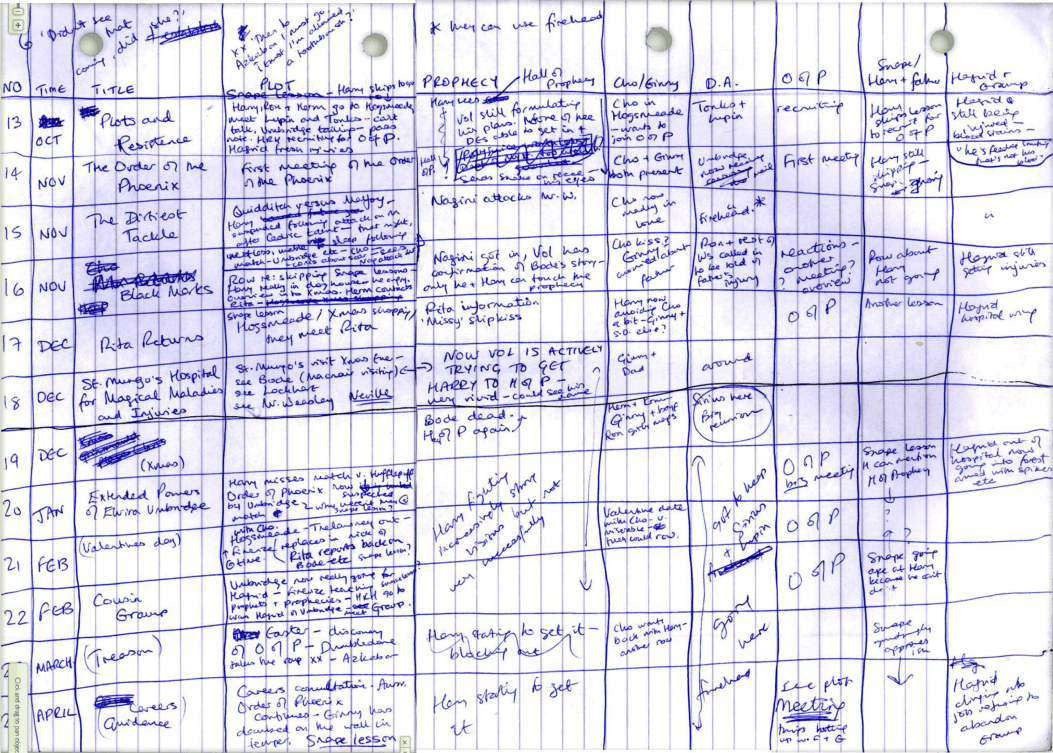
1.) Here's also: J.K. Rowling's Plot Map of Harry Potter Book 5 (or so says the internet). This is actually really helpful for those like me who like seeing how other authors keep track of their plots.

2.) I particularly like this link on "plot maps" because in addition to some wonderfully helpful novel plot map ideas 9At the top of the linked page), it also features a large number of garden plot maps, and even one or two cemetary plot maps! :) So, I'm including it here for the novel plot maps section (click here) but, ha ha ha, all of the plot maps on the site could probably be used in some form of novel plotting - depending what you're writing about.  :)


Ok, back to our interview! Megan, here’s a fun question: If you could have written any book that’s already been written by someone else, what book would it be, and why do you wish you had written it?

I’d have to say STOLEN by Lucy Christopher. It’s a similar premise to the YA psychological thriller manuscript I wrote once, but STOLEN is about a thousand times better. I love everything she does with the setting, mood, romance, and moral ambiguity of that book.

Sounds like a great book, Megan!  I’m sure many readers of this post are now running off to read it!
I’m really looking forward to reading the Madman’s Daughter, as well!
It’s been a pleasure having you here on the blog.  Here’s one final question:


What would you say have been the three most exciting moments for you so far in your writing and publishing journey? J

Well, the most exciting moment was when I got “the call” from my agent, Josh Adams, offering representation. I had only submitted the manuscript the day before, so I was totally unprepared for such a quick response. I was at my day job and hid in my boss’s office most of the rest of the day because I was so stunned and excited I couldn’t even think about my regular work. Josh loved the manuscript as much as I did, and his enthusiasm made me realize my publishing dream might be closer than I thought!

Two other great moments were calling my parents to tell them THE MADMAN’S DAUGHTER had sold (as booksellers, they were ecstatic), and going to New York to meet my editor and the HarperCollins team for the first time. I felt like a real writer!

Those are three wonderful-sounding moments in a line up of what I’m sure will be many more!  I’m glad to see that sharing the news with your parents made the list! J Our families are often our most ardent supporters, and the ones who read our first manuscripts when we were new to the profession and still had so very much to learn! 

I want to include on final link on this interview.  This is a wondeful blog post that Megan recently wrote about what it REALLY takes to be a successful writer.  For all of the writers out there I would recommend that if you don't read anything else today, DO READ THIS:  Attitude Makes the Writer.  It's the most inspiring and truthful blog post for writers that I've read in a long, long time.
Thanks, Megan, for letting me share it here!
- Janelle