Monday, March 15, 2010

No Longer Afraid of the Red Pen


We all remember them. Those moments in fourth grade when our teachers would hand back our papers and exams marked up with red pen.
It was horrible.
To our minds -- and to our peers -- the red markings meant: "This isn't good enough. You screwed up," or perhaps even, "Can't you get this right, yet? What are you, stupid?"

But now, I'm all grown up. And five years into this task of joining the writing profession, I always hand my manuscripts to my critique buddies accompanied by a RED PEN. It's true!
You see, when we start in this profession, and join our first critique group, all our fears from fourth grade still stick with us, I think. We hand our manuscripts to our new crit buddies with trembling hands, and a bit of nervous nausea. We stash a first-aid kid of band-aid's and emotional salve (chocolate) in our book bags -- just in case these critters say something negative about our work and it makes us want to jump off a bridge in dispair. We look for gentle comments like: "You know, I think this chapter is really wonderful, and probably ready for publication right now...except that perhaps just one or two of your sentences, if even that, out of the whole book, are a bit convoluted and long. That's all. Easy to fix. And really - I could be wrong about that. I love it!"
Awesome! We can handle that critique. It sounds like it means our work is basically perfect.
Of course, we know they're lying...ehem. They're being nice to us so we don't run off crying.
But now, two and a half novel manuscripts into this business of writing fiction, my heart is stronger; my determination is more profound.
I don't want to publish "reasonably good" books. I want to publish "REALLY good" ones.

So, now I hand out the red pens with all of my manuscripts.

Why? Well, for one thing, it's easier to find the comments of my crit buddies among the black and white type, if they're written in red ink. But more than that. It's because I really want those comments to be honest -- perhaps even more honest than my fourth grade teacher was.
If the plot is shabby, or the sentences are too long, or my grammar is off, or my dialogue is `too adult,' I want to know it. And truthfully, we don't always notice these things in our own writing the way that we notice them in other people's. So mark it up, my friends. I can take it!
Sure, I still keep my little package of band-aids and chocolate -- just in case the "truth" means I'll have to go do some frustratingly in depth revision, right when I thought the manuscript was ready for submission to editors and the like. But these days I leave my first aid kit farther away, in the car, rather than keeping it in my bag. That's because now I really want to make the hard corrections if I need to -- even though it's heart-wrenching. (gulp). Better to change our manuscripts before they go to editors, than to skip that step, and send them something "good but not great," which they won't have the time or motivation to read.

So hooray for the red pens -- and for the critique buddies who aren't afraid to use them!
(Of course, handing out cookies when you hand us back our manuscripts with those red markings is never a bad idea either. Remember that great old red-coolaid and all those cookies we enjoyed in elementary school? There was a reason for that.)
As all fourth grade teachers know...
A combination of Red Truth and Chocolate just may be the best way to create GREAT writing.

Tuesday, February 23, 2010

100 Dresses and a Few Greek Gods


Those of us writing for children and teens hold a secret underlying hope. Even if we're writing
fantasies about elves and fauns, sci-fi's about robots and aliens, or humorous middle grade boy books about disgusting things people rarely discuss, we secretly hope that our stories will reach children, teens, (and even the adults who often read YA,) at the deepest places of their minds and hearts. We want our books to strike emotional chords that will cause our stories to live within our readers forever. Mwa Ha ha!
.

That's why I'm always so thrilled to see the many children's and teen books that are moving forward into the wider world of pop culture these days. In the past two years alone we've seen hugely successful movies based on the Twilight books, the Narnia books, Harry Potter #6, and many others. What excites me about this continuing trend is that these stories did not come straight from screenwriters, or other people on the cutting edge of the fast-paced new technology loved by teens. Nope -- these tales were first published in paperback books -- novels and middle grades typed by authors at coffee shops while their own kids were off at school. The books have been so well loved by so many kids, teens and adults that they've found their place in popular culture through film, and music, t-shirts, and toys..


This trend seems to affirm the idea that books aren't on their way out. They're on their way up. And so of course we all want our books to be wonderful enough for Barnes and Noble and Amazon, but equally so for Paramount, Dreamworks, Disney, and Mattel...
And just as we support our fellow writers by attending their book signings and speaking engagements in book-stores around the area, it seems to me we should applaud this pop-culture trend, and celebrate our fellow writers' success in film, song, and theatre as well.

.
Four current opportunities to attend showings of Kid's and YA lit in Pop Culture in NC include (click the blue links):


The Hundred Dresses: A play, at the Raleigh Little Theatre (March 12-28, 2010)
1st written in 1944 by Eleanor Estes, this book for 9-12 year olds was one of my top 10 favorites in elementary school. It's the story of an impoverished little girl from Poland who lives in the U.S. and gets picked on at school b/c of her poverty -- also because she tells all her classmates that she has "100 dresses" in her closet at home, though she wears the same one to school every day. "The Hundred Dresses" is a story of bullying, poverty, and creativity in which two girls
who have picked on poor Wanda Petronski learn the hard way that their words really hurt a creative little girl who really did have 100 dresses in her closet -- colorful dresses, on paper, that she'd drawn. Sweet Wanda leaves them for the girls when she moves.


Percy Jackson and the Olympians: The Lightning Thief, The Movie -- In Theaters now.
This YA novel by Rick Riordan features Percy Jackson, the confused son of a single mother,
who doesn't know the father who abandoned his family when Percy was a baby is actually the Greek God Perseus. But when an argument between the Ancient Greek gods puts the world at risk, Percy finds out quickly who he is, where is power lies, and how much trouble he's about to get into on his mission to prevent a war between his powerful, immortal "aunts and uncles."

Alice in Wonderland: The Updated Movie - In Theaters soon.
Alice and the Red Queen face off in a war that has all of Wonderland up in arms.

Diary of a Wimpy Kid, In Theaters soon.
In this, the first of Jeff Kinney's comic novel series, a Middle school student, Greg Heffley, takes readers through an academic year's worth of drama.

.
Have fun checking out these great children's stories that are making it big in theaters and on stage this Spring!

Saturday, February 6, 2010

Seeking Submissions: 2 Anthologies and a Contest


In this edition of Writermorphosis we have a Guest Blogger: George Anthony Kulz.

George is a friend of mine and an expert on where to find -- and how to submit to -writing contests and literary compilations. He’ll be stopping by Writermorphosis every few months to post upcoming contests and opportunities, and today is his first guest post. Welcome George!

George suavely knows about writing contests before the rest of us, somehow. And he wins them too. He’s won the Gotham Writers' Workshop 100 Word Writing Contest, the readers' choice contests in knowonder!, (twice,) and the 2010 NYC Midnight Tweet Me a Story contest. His published short stories have appeared in Wee Ones Children’s Magazine, Spider, Happiness, The Nautilus Engine, Characters, Spaceports and Spidersilk, Stories for Children, Stories That Lift, The Drabbler, and knowonder!. George lives in Rhode Island with his wife and four kids. He currently spends his non-writing time working as a software engineer in a hospital.

Without further adoo, here's George's post:

“Most of you have probably set some writing goals for this year, and I hope that some of the contests and market ideas that I mention here will help you achieve those goals. Here are three markets that might be of interest. The first two are related to the same publisher.

1. Rebel Books, LLP is putting together an anthology of faerie stories for young adults, to be published in mid 2010. They are seeking modern, original stories about or including faeries, with an edgy teen focus. The closing date for submissions is 2/28/10. You can find info here: http://rebelbookspublishing.co.uk/submissions.aspx. They are a paying market, and it costs nothing to send them stories.

2. Rebel Books, LLP is also putting together an anthology of magical themed stories for kids ages 7+. Stories should have a magical, fantastical theme to capture and hold the reader's attention but should still be original and modern. The closing date for submissions is 5/31/10. Again, the website is: http://rebelbookspublishing.co.uk/submissions.aspx.

3. Finally, the Cassell Network of Writers is putting on a writing contest with a children's writing category, called the 2010 Writers-Editors Network 27th Annual International Writing Competition. There is an entry fee, but if you are a member you can get 50% off the entry fee. The contest deadline is 3/15/10. Find information by clicking the link above.

That's all for this time. Stay tuned for more markets & contests - George.

Tuesday, January 5, 2010

Join other Writers in Supporting "Room to Read"


Every year it seems bloggers across the globe use their first “post” after New Years to encourage their readers to make personal goals for the coming year. Many writing websites are encouraging us to make goals for what we hope to accomplish professionally in 2010. I like this strategy, somewhat. Afterall, as writers we sometimes do need to make goals for ourselves at the beginning of the year to keep ourselves on track so we will keep writing during the slump days, or when rejections roll in. It’s helpful to have a goal like “I’m going to finish my current novel by July,“ or “I’m going to write 6 pages a day until next Christmas.“ This keeps us accountable and keeps us moving forward. But what about the big world that’s out there, outside of our houses and outside of our books. Can the writing that we’re doing make an impact there as well?
.
I think so. The other week I received in the mail the sponsorship magazine for Heifer International. Heifer uses donations from folks in the industrial world (us) to help families in third world countries develop farms of chickens, cows, ducks, rabbits, bees, or other animals that can provide them with ways to make a living, grow crops, and feed their families. In the center of the magazine I found an article called “A Novel Approach.” It told how two adult fiction writers (Pat Rothfuss, and Laurie R. King) used the publications of their recent books to raise more than $150,000 in donations for Heifer’s international relief work.
And that got me thinking. Why can’t those of us writers who are out here slugging away typing word after word each day use helping others as the motivation for keeping our writing moving along in 2010? I think we can.

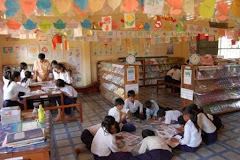
So here is my idea. There’s a non-profit organization based in the U.S. called “Room to Read.” Room to Read believes that putting books in the hands of children in developing countries can change the world by increasing educational levels and thus improving communities‘ abilities make a more sustainable living. Room to Read uses donations from people like you and me to build and stock children’s libraries and classrooms in third world countries, to promote elementary school programs for girls in countries where females often have to stay home from school to run their households, and to publish children’s books in languages that don’t have many available.


This year I want to support Room to Read, and I’m hoping some of you will join me. I’d love to see us children’s writers build a library in a part of the world that needs one.
So this is my plan. From February until April I plan to donate 1 cent to Room to Read for every 2 words I write on my current novel. This won’t amount to a lot of money, because frankly, it’s a tough economy right now and I’m not J.K. Rowling. : ) But it only takes $2,500 for Room to Read to build a children’s library in Africa or South East Asia. Every penny adds up.


So...if FIFTY of you and your writing friends join me, even if each of us only writes 10,000 words from February-April 2010 (which it‘s likely we could write much more), at 1 cent per 2 words written, we could build a whole library through Room to Read.
Yes, 50 of us, at 10,000 words, at 1 cent for every 2 words, could build a library!
Of course, we will have to actually raise money and pay it in to Room to Read, (1 cent for every 2 words written) or it won’t help children in another country get books at all. But we can do it.
If you think this sounds like an expensive endeavor, it's not. Ask people who want to support and encourage you as a writer to sponsor you. That will make this a community event and we‘ll raise even more cash for Room to Read! Get your mom, dad, your husband or wife, your great aunt Sue, your son’s youth group if they like your writing, (and for those who have books published, invite the fans who are awaiting your next book,) to each sponsor you for a penny for every 2, 5, 10, or 15 words you write. Your editor might even think it's a great marketing campaign! Either way, it will help you get a lot of writing done, and it will help kids who don't have enough books to read get a library.
.
So here’s the math:
10,000 words@ 1 cent per every 2 words = $50.00
10,000 words @ 1 cent per every 5 words = $20.00
Get 5 friends to sponsor you and that turn into $250.00 or $100.00 And you’re off to a great start!
Get 10 friends to sponsor you, and you’re off and running!

20,000 words@ 1 cent per every 2 words = 100.00
20,000 words @1 cent per every 5 words = $40.00
With 5 friends to sponsor you that turns into $500.00 or $200.00. Not too shabby, even in a bad economy!
Can’t think of five friends to sponsor you? That's not a barrier. Sponsor yourself. You’ll be getting lots of writing done, while changing the world one children’s book at a time.
And hey, if you write 500 word picture books, : ), get your friends to sponsor you for 5 or 10 cents a word. We can all play at this game, to help build kids a library. : )

DO YOU WANT TO JOIN ME? It’s easy: I’ve given us a name through Room to Read (“Children’s Writers United”) and we have a webpage on the Room to Read site already set up (click on our name, above).

You can download the widget THERMOMETER that will track the money as it comes in. You can place a "thermometer" on your website or blog (like the one on mine,) so that your blog readers can see our progress and join up as well. (If you have trouble downloading the thermometer, let me know). And remember, the thermometer will probably remain low until the end of April, when hopefully all your sponsors will pay you, and then it should shoot up. I’ve started us off with $25.00. Let’s see where we can take it from here!
Please let me know if you’re taking this challenge. And please make a note about it on your blog to spread the word.
Let's make all our words, whether beautiful or "really first-drafty," be worth at least a half-penny!

Tuesday, December 15, 2009

A Holiday Look Back at a Year of Writing


To the members of SCBWI Carolinas
To the Goalies :)
To the attenders of the Oregon Coast Children's Book Writer's Workshop
And to the many other authors, editors and agents of the worldwide writing community who I've had the pleasure of spending time with and learning from this year...

Here's a glimpse back at the 2009 we've had together.

Happy Holidays to all as we write our way into a new year!

- Janelle

Tuesday, December 1, 2009

Writing Historical Fiction


I arrived on this earth after Martin Luther King was shot, after most “flower children” stopped protesting Vietnam, quite a few years after the Holocaust, and many, many, MANY years after the American Revolutionary War. The same can be said for many of you.
And yet we know about those people and events listed above. How? We learned about many of them from reading “historical fiction” books like Johnny Tremain, Number the Stars, For Freedom, The Lion, the Witch and the Wardrobe (Ok, so it's a fantasy, but the first few chaps are about WWII :)), Sweet Clara and the Freedom Quilt, Al Capone Does my Shirts, Healing Water, Samarai Shortstop, The Brooklyn Nine, The Scarlet Letter, and One Million Men and Me.

So today let’s talk about historical fiction: books set in the past, with characters from the past, that resonate with kids and teens today.

At the SCBWI Carolinas Annual Fall Conference not long ago, our own NC Historical Fiction guru Joyce Moyer Hostetter, (author of “Blue,” and other great books of historical fiction books for teens,) shared the following tips for “Writing Historical Fiction for Young People.”

She said:

In writing historical fiction, the author should:

1.) “Find the story” --- It might be a historic event, person, or theme in your own back yard, neighborhood, or your own family’s history.
2.) “Tell the time” --- Along with your plot, include in your story things that give the reader a sense of the era the story happens in. This can be done by including dates, having your characters speak in phrases and words common at that time, and grounding your story among political events and the cultural backdrop of the era.
3.) “Ask the Experts” --- People love to be interviewed about their own life experiences. “You validate their story by (incorporating their knowledge of the time and their experiences into your story and) telling it well.” Joyce says “People want to share with you. So be really brave about calling total strangers.”
4.) “SHOW the place” --- Include in your story local landmarks, vivid nouns and adjectives detailing the food, plants, and local features of your setting. “Readers love to read about places in their own home town, and speech patterns they recognize.”
5.) “Cite your sources” -- Editors want to publish your book with confidence, knowing that those little tidbits of place, time, dialogue, and event are historically accurate. So cite all those sources you used!

But where does a person come up with a story for historical fiction? And how do we find out more about those historical facts, events, and people that we‘re thinking of writing about?

Joyce suggested some great resources:
Ÿ Historical photos of people and buildings
Ÿ Old newspapers
Ÿ Old letters and diaries
Ÿ Memoir’s related to your topic
Ÿ Museums
Ÿ Songs/Music from the time you are researching
Ÿ Dictionaries
Ÿ History books
Ÿ “Writer’s digest books on historic time periods”
Ÿ And websites like http://www.si.edu/ (The Smithsonian Institute,) and http://www.loc.gov/loc/infopub/ (The Library of Congress).


So, if you feel like you’re ready for a new writing project perhaps you should flip through your great aunt’s old photo albums, reminisce through your old high school year books, or start wandering around the old buildings in your city or state. You never know what you might find… and the story that comes out of it could be brilliant!

Saturday, November 14, 2009

YA Goes All The Way


The other day one of my co-workers remarked to a couple of our friends that
“Janelle writes children’s books.” The customary “Ooh, isn’t that wonderful…”comments were exchanged – the ones that mean they think I write stuff like Winnie the Pooh and Babar the Elephant -- stories for elementary school kids.
Trying to explain that I generally write for “young adults (YA),” would have made the conversation too long. So I listened and nodded, and smiled a little when someone said “it’s so great that you can still write (upbeat) stuff like that in this day and age when there are so many people who are so jaded.”
At that point in the conversation I figured it would probably shake things up too much to mention that the manuscript I have out circulating involves a lot of family conflict and a 300 year old `murder’ mystery, and that the story I’m currently writing has a narrator who’s a homeless teen. : ) But YA literature can show the reality of life with a little less sunshine than what the younger kids read.
So what can we write about in YA, anyway?

David Gill, author of the YA book Soul Enchilada, answered this question at the recent SCBWI Carolinas Annual Fall Conference. Here is his list of what can be found in a YA book:

“YA,” he said, “is not a genre, it’s a marketing category.”
YA books have a teen story-problem and a teen main character.
They are written for a teen audience.
They are told in a `here and now’ (teen) perspective, rather than with a narrator who is an adult looking back.
In YA the story “starts with the action and story, and ends with the action and story.”
YA is “reaching for college readers, becoming more truly young adult, and allowing more complex and darker themes, lately. Some YA books are also getting longer, and the themes and writing more complex.
David also quoted Scholastic Editor Cheryl Klein as noting that YA stories are “centrally interested in the experiences and growth of the book’s teen protagonist.”

So what is the difference between Middle Grade books (written for kids between approximately the ages of 9 and 14 years of age,) and YA? In a word, David said, it’s "intensity.”

He gave the following examples:

MG book = a character may sneak a kiss
YA book = a character might have sex or even get pregnant

MG book = bullies may push, pull or perhaps call names
YA book = Bullies can beat you up

You get the idea. And whatever age you’re writing for, remember: “your main character should be roughly 2 years older than your target reader’s age.”

Now go forth. And if you’re writing YA it’s ok to let that little jaded sarcastic teen in you write about tough issues. It’s ok to Go All The Way.